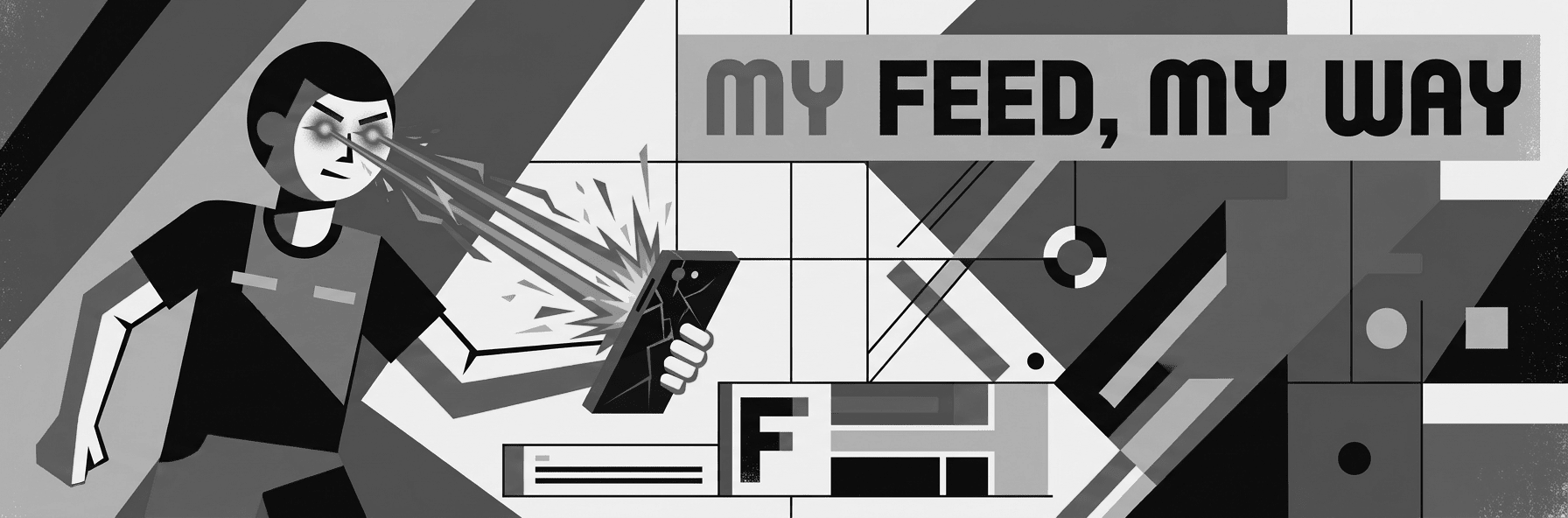
Australia’s proposed “My Feed, My Way” or the Online Safety Amendment (Digital Duty of Care) Bill is a significant departure from Australia’s previous bills, and a direct challenge to how platforms dictate users’ social media feeds. The basic idea is fairly simple: give people a choice over whether an algorithm dictates what appears in their social media newsfeed or a straight chronoligical feed based on the accounts that a user has chosen to follow.
The proposal follows Australia’s pioneering attempt at age restriction, in force since late 2025, with what is widely seen as a failure; 81.5% of under 16s still on social media three months after the ban compared to 85.9% before the ban. This is an attempt at a design change rather than a ban.
What does “My Feed, My Way” actually do?
“My Feed, My Way” is not law yet. It is part of an exposure draft of Australia’s proposed Online Safety Amendment (Digital Duty of Care) Bill 2026, released on 8 September. Consultation closed on 22 September, and the government has said it intends to introduce legislation later this year, a remarkably short amount of time compared to Brussels-based rulemaking.
The proposal would require relevant platforms to give users over 16 a choice between an algorithmically curated feed and a feed based on accounts they have chosen to follow.
Beside that change are extra powers for the Minister who may, by legislative instrument, require online services to provide specified “user empowerment tools”.
The feed toggle everyone is arguing about is therefore the government’s stated intention for how that power will be used, rather than a fully drafted requirement.
For under‑16s, the draft goes further: it treats recommender systems, endless feeds and related engagement features as “negative behavioural impact” design features that must be disabled. A more concrete, directly drafted prohibition, alongside the more flexible, ministerially defined feed‑choice regime for users over 16.
The wider Digital Duty of Care bill also spells out what counts as harmful to children: pornography; material that encourages or instructs disordered eating; material that promotes hostile attitudes towards women or gender equality; material that glorifies crime or encourages dangerous stunts; and abuse, harassment or bullying.
Non-compliance with the duty of care more broadly can attract penalties of up to A$109.2 million– almost enough for a rounding error given Meta makes $550 million a day. The important question is whether that creates enough incentive for platforms to take the softer obligations seriously or they will simply see it as an operating fee.
The draft does not simply say “give everyone a chronological feed”, nor does it ban people from posting political opinions. It does not prevent creators from having audiences.
There are, however, legitimate questions about the proposal itself. What counts as a meaningful choice? How easy should the alternative feed switch be to find? What happens if the platform technically provides the option but makes the algorithmic feed much more attractive? It is not clear if the law will make chronological feeds the default, simply prompt users to choose or provide a switch somewhere in the user interface.
Those things matter because, as the EU has seen from the implementation of the Digital services Act (DSA), a right on paper is not necessarily the same thing as it working in practice.
The government’s stated rationale is to reduce addictive design and exposure to harmful content, including disordered‑eating material, misogynistic or “manosphere” content, and other material that can damage young people’s wellbeing. Critics will ask why similar design‑based approaches have not been applied to other addictive environments, such as online gambling – a significant problem in Australia – but the bill’s focus is squarely on social media and related digital services.
Walled gardens
Despite platform CEOs’ insistence to the contrary, social media platforms are not public spaces.. They are walled gardens. They are not just simple staging areas for user content; they organise it and often prevent users from adding links to external content. This includes recommender systems and trust and safety – things like flagging, de-prioritising, shadow banning, and notice and takedowns for hate speech, CSAM, violent videos and other illegal content or content deemed harmful by the platforms’ own rules.
They decide what appears in your feed, what gets recommended, what is searchable, what gets amplified and what disappears. They also have strong commercial incentives to keep people inside their own environments.
This raises a question about who should have power over the way online discourse is shaped and whether these digital public squares are actually part of democratic infrastructure.
Australia’s own eSafety Commissioner made a similar case in its May 2026 position paper on recommender systems. Boys and young men are consistently pushed manosphere content regardless of whether they actively search for it. Only around a quarter of users ever touch the content controls platforms already offer them. And platforms routinely downrank so-called “borderline” content, content that skirts the rules without breaking them, in ways which are never explained or accounted for.
A toggle does not necessarily mean control
The international evidence on what a chronological alternative actually fixes is more mixed.
A large field experiment with Facebook and Instagram users during the 2020 US election, published in 2023 by researchers including at Stanford GSB, found that moving people to reverse‑chronological feeds substantially cut their time on the platforms and changed what they saw. Despite these behavioural and exposure effects, the study detected no significant shift in political attitudes, polarisation or political knowledge over the three‑month period.
A 2026 study in Nature, based on a seven‑week randomised experiment with US X users in 2023, found that switching people from a chronological feed to the “For You” algorithmic feed increased engagement and shifted political opinions to the right on specific policy questions and current events. Switching the algorithm off again did not reverse that shift, partly because users had followed more right‑leaning accounts during the algorithmic phase and continued to follow them.
The algorithm’s effects seem to run partly through who you end up following, which persists regardless of the setting, not just what you are shown in any given moment.
A toggle offered after the fact may therefore do considerably less than advertised.
That points to a problem with the over-16 threshold too. An opt-out only really does its job for someone who is offered the choice before an algorithm has had years to shape their own information bubble. Someone who has spent their teens and twenties on an engagement-optimised feed has already had that list built for them. Flicking the switch off does not unbuild it.
Europe is asking some of the same questions
Europe is asking some of the same questions — and it has also been watching Australia directly.
At a UN event in New York in September 2025, held alongside Australian Prime Minister Anthony Albanese, Commission President Ursula von der Leyen said she was “inspired” by Australia’s legislation banning under‑16s from social media platforms. She added that Europe was “watching and will be learning from you” as Australia implements what she called its world-first, world-leading social media ban, while criticising platforms for using addictive, manipulative algorithms designed to maximise profits.
Under the Digital Services Act, very large online platforms and search engines that use recommender systems must, among other things: avoid dark patterns (Article 25); provide clear, accessible information and control over recommender systems (Article 27); and offer at least one recommendation option that is not based on profiling (Article 38).
In September 2025, the Dutch NGO Bits of Freedom sued Meta in summary proceedings, arguing that its interface violated those obligations. The Amsterdam court found Meta Ireland not compliant with Articles 27(3) and 38, ruling that the way the non‑profiling feed choice was implemented — including the tendency to switch users back to the algorithmic timeline — amounted to a prohibited dark pattern under the DSA. The Court of Appeal upheld that finding on 10 March 2026 (the original District Court ruling was 2 October 2025) and raised the maximum penalty for non‑compliance from €5 million to €10 million.
The EU is also moving towards more prescriptive rules around how children encounter online content. On 17 September 2026, the European Commission presented its proposed EU Kids Act, which would introduce age-based access rules alongside a stronger emphasis on safety by design.
The proposal would establish different rules according to age. Under-13s would be prevented from accessing social media, while 13- and 14-year-olds would have mini accounts with parental monitoring and certain restrictions. From 15, children would be able to have independent accounts. The proposal also targets design features intended to keep children engaged, including infinite scroll, autoplay and other forms of addictive design.
This is significant in the context of “My Feed, My Way” because the two approaches start from almost opposite points. Australia’s proposal asks what happens when users are given more control over recommendation systems. The EU Kids Act asks what platforms should be prevented from doing to children in the first place.
They are not competing versions of the same policy, and the EU proposal is still only a proposal. But both reflect a growing willingness to regulate the design of online environments rather than treating platforms simply as neutral hosts for user-generated content.
The differences become clearer when the approaches are put side by side.
EU rules vs Australian rules, side by side
| EU Kids Act (proposal) | EU Digital Services Act | Australia: My Feed, My Way | Australia: social media minimum age | |
|---|---|---|---|---|
| Status | Commission proposal; Parliament and Council still to agree final text | In force, applicable to online platforms now | Announced government initiative | In force since 10 December 2025 |
| Main approach | Age-based access restrictions plus safety-by-design requirements | Risk-management and child-safety duties for platforms | Choice between personalised and non-personalised feeds | Platforms must take reasonable steps to keep under-16s off |
| Under-13s | No social media access; limited child-friendly services via parent-managed account, capped at one hour a day | No general EU-wide ban | Not an age-ban measure | Covered by the broader under-16 restriction |
| Ages 13-14 | Parent-managed “mini account,” limited features, capped at one hour a day | Platforms must protect minors’ privacy, safety, security | Recommender systems already banned outright as a “negative behavioural impact” design feature for this age group, ahead of any feed-choice mechanism | No account permitted |
| Ages 15-17 | Independent account permitted from 15 | Reduced risk obligations; no profiling-based ads to known minors | Over-16s can opt out of personalised feeds | 16-17 year-olds generally permitted |
| Age assurance | Required; privacy-preserving EU tooling proposed | Encourages accurate, non-intrusive methods where appropriate | Not the central mechanism | Platform’s choice of method; no forced ID/Digital ID without a reasonable alternative |
| Algorithmic feeds | Would restrict profiling-based recommendations and addictive features for minors | Requires risk assessment; bans profiling-based ads to minors; VLOPs must already offer at least one non-profiling feed option (Article 38) | Users choose feed based on followed accounts instead of recommendations | No feed-choice requirement in the minimum-age scheme itself |
| Addictive design | Targets infinite scroll, autoplay, engagement rewards | Requires platforms to protect minors’ safety and wellbeing | Broader duty of care also covers harmful design for under-18s | Since March 2026, “age-restricted platform” status itself now turns partly on recommender features and endless feeds, not just account access |
| Who’s responsible | Mainly platforms, especially very large ones | Online service providers and platforms | Platforms must offer and respect the feed choice | Platforms, not children or parents |
| Geographic scope | EU-wide if adopted | EU-wide | Australia | Australia |
| Central idea | Children should access online services progressively and safely | Platforms must manage risks and protect minors | Users should control whether their feed is personalised | Under-16s shouldn’t hold accounts on covered platforms |
Sources: EU Kids Act · EU Kids Act, addictive design detail · Digital Services Act · My Feed, My Way · social media minimum age. Age assurance and minimum age (OAIC).
The Kids Act takes a different approach again, placing responsibility on platforms to constrain harmful design before it reaches children at all, rather than asking users to opt out of it afterwards. That same question, who actually gets to exercise control, is also live in a different part of both bills: access to the platforms’ own data.
A concern for digital rights advocates in the EU is how age verification for the under-13 ban would actually be implemented. It’s technically difficult to do and easy to circumvent. It also carries privacy and data-security risk, since it means platforms verifying and retaining sensitive user data. This is too complex to tackle properly here, since it relates to the GDPR and the derogations proposed in the Digital Omnibus, but is worth its own piece.
Researcher access
Another provision both in the EU’s DSA and Australia’s proposal creates a path for access to researchers to obtain platform data. Researchers have reported prolonged waiting times, arbitrary refusals, incomplete access and restrictive platform conditions, most visibly in the Democracy Reporting International case, where X denied a request ahead of Germany’s February 2025 Bundestag election until a court ordered access, and as documented in this SSOAR paper. The Commission’s framework also distinguishes between publicly accessible data under Article 40(12) and non-public data under Article 40(4), the latter involving additional vetting and a process that can take up to 175 working days, nearly nine months.
Australia’s proposed framework raises a different but related concern. Under sections 205B and 205C of the exposure draft, an “approved researcher” must be employed by an Australian university, obtain approval under the legislative rules and conduct research approved by a university-linked human research ethics committee. Unless the final legislation creates a route for independent public-interest researchers and civil-society organisations, this could leave important expertise outside the scheme. Australia should therefore learn from the EU’s early experience: access rules need broad eligibility, clear deadlines, transparent reasons for refusal, meaningful appeal rights and coverage for non-academic public-interest research.
Maybe the old internet was not so bad
There is a certain nostalgia for the old internet. It was far less centralised around big platforms and offered users more choice over how their internet looked and who they interacted with. People chose which websites to visit, followed blogs, joined forums and sought information with intent.
Misinformation, harassment, propaganda and odious arguments still existed, but there was a distinctly less toxic ambience to it.
Today, the internet just comes to us via a small number of walled gardens that have enormous power over what information reaches us and how it is presented without disclosing how or why, and offering users little in the way of agency.
“My Feed, My Way”, like other similar attempts at platform regulation, will not fix that. It will not eliminate misinformation, polarisation or even make political debate more rational and nuanced.
But perhaps that is the wrong standard.
The interesting question is whether giving people more control over their feeds can become part of a broader shift towards user agency: meaningful transparency, appeal rights, interoperability, data portability and genuinely usable alternatives to the platforms that define the informtion space so absolutely.
We do not need to romanticise the old internet. But there is also no reason to accept the current one as inevitable.
Questions for reflection:
- Comprehension: What does the “My Feed, My Way” exposure draft actually require platforms to do, and what parts of it are left to a future ministerial instrument rather than drafted into the bill itself?
- Application/analysis: Given the Nature study’s finding that switching off an algorithmic feed doesn’t reverse who you’ve already ended up following, what would a feed-choice policy actually need to look like to work, and does anything in the Australian or EU approaches come close?
- Open-ended: Is a feed toggle a meaningful form of user agency, or does real digital empowerment require something more structural, like interoperability or data portability? What would that actually look like in practice?